01 · Executive Summary
The skills that protected you no longer differentiate you
Ten years ago, mastering RAC and ASM almost guaranteed a stable Oracle career. In 2026, those skills remain valuable — but they are no longer enough.
The Oracle DBA role isn't disappearing. It's being absorbed into something larger. When workloads move to Oracle Cloud Infrastructure, the storage layer you spent a decade mastering becomes a managed service. The cluster you hand-tuned becomes a provisioning API call. Disaster recovery you architected by hand becomes a checkbox and a region selection. None of your knowledge becomes worthless — but the scope of where it applies changes overnight.
Three forces are converging at once. First, Oracle's own roadmap now assumes the cloud is the default deployment target, with Oracle Database 23ai shipping AI Vector Search directly inside the engine. Second, the multi-cloud era is here in earnest: Oracle Database@AWS, Oracle Database@Azure, and Oracle Database@Google Cloud mean the same Oracle database now runs inside three hyperscalers. Third, enterprises no longer hire someone only to keep the database alive — they hire someone to design the system the database lives inside.
This is the opening for the DBA. You already understand consistency, recovery, performance, and failure better than almost anyone in the building. The transition to OCI Architect is not about abandoning that — it's about extending it upward, into networking, automation, security, cost, and AI-native design.
OCI architecture skills, not certifications, command the largest salary premium — typically a 40–90% jump over a senior DBA in the same market.
Networking — not Terraform or AI — is the single hardest gap for experienced DBAs to close on the OCI Architect career path.
The 23ai + multi-cloud shift creates a new role most DBAs are uniquely positioned for: the AI Database Architect.
02 · The Reality Check
"I was the person everyone called at 3 a.m. Then nobody called."
Raj is a Senior Oracle DBA. Twelve years in. He is genuinely expert in RAC, ASM, Data Guard, and performance tuning. He could read an AWR report the way a doctor reads an X-ray. For most of his career, that mastery was his moat.
Then his organisation started migrating workloads to OCI.
Suddenly the ground shifted under the parts of the job he was proudest of. Storage became a managed service — no more LUN planning, no more ASM disk group rebalancing at midnight. Provisioning became automated — a Terraform plan spun up in minutes what used to take his team three weeks of change tickets. Infrastructure became software — defined in code, reviewed in pull requests, deployed by a pipeline. Raj hadn't become less skilled. the job had simply grown a new layer above the one he lived in — and the people designing that layer were getting the interesting work, the architecture reviews, and the raises.
If you recognise yourself in Raj, this article is written for you. Not as a eulogy for the DBA, but as a blueprint. Because here is the part nobody tells Raj at the start: the architect designing that new layer almost always does a worse job of the database parts than Raj would. The market is short of people who can do both. That scarcity is your leverage.
03 · The Shift
From database administrator to cloud architect
The change is less about new tools and more about a change in altitude. A DBA optimises a system. An architect decides what the system should be. The DBA asks "is this database healthy?" The architect asks "should this even be a database — and where should it live, who can reach it, what does it cost, and how does it fail?"
Crucially, the architect doesn't stop caring about the database. They simply own a wider blast radius. Here is the honest mapping of how the day changes.
| Traditional DBA responsibilities | OCI Architect responsibilities |
|---|---|
| Provision storage, plan ASM disk groups, manage LUNs | Select Block/Object/File storage tiers; design for durability and cost |
| Configure RAC for high availability on owned hardware | Design HA across fault domains, availability domains, and regions |
| Build Data Guard standby for DR | Architect multi-region DR, RTO/RPO targets, failover automation |
| Tune SQL, manage AWR, chase wait events | Own performance and the network, IAM, and capacity around it |
| Run RMAN backups on a schedule | Design backup policy, retention, immutability, and recovery testing |
| Apply patches during maintenance windows | Define lifecycle, automation, and zero/low-downtime patching strategy |
| Respond to incidents (reactive) | Design observability so incidents are prevented (proactive) |
| Serve one or a few databases | Set standards (landing zones, guardrails) for the whole estate |
| Document for the team | Justify decisions to security, finance, and leadership |
You don't lose the database. You gain everything around it — and that "everything around it" is where the title, the scope, and the compensation live.
04 · Technical Architecture
The transformation stack
Think of the transformation not as a leap but as a stack you climb one layer at a time. Each layer rests on the one below it. Skip a layer and the whole thing wobbles — which is exactly why DBAs who rush to AI before understanding networking struggle.
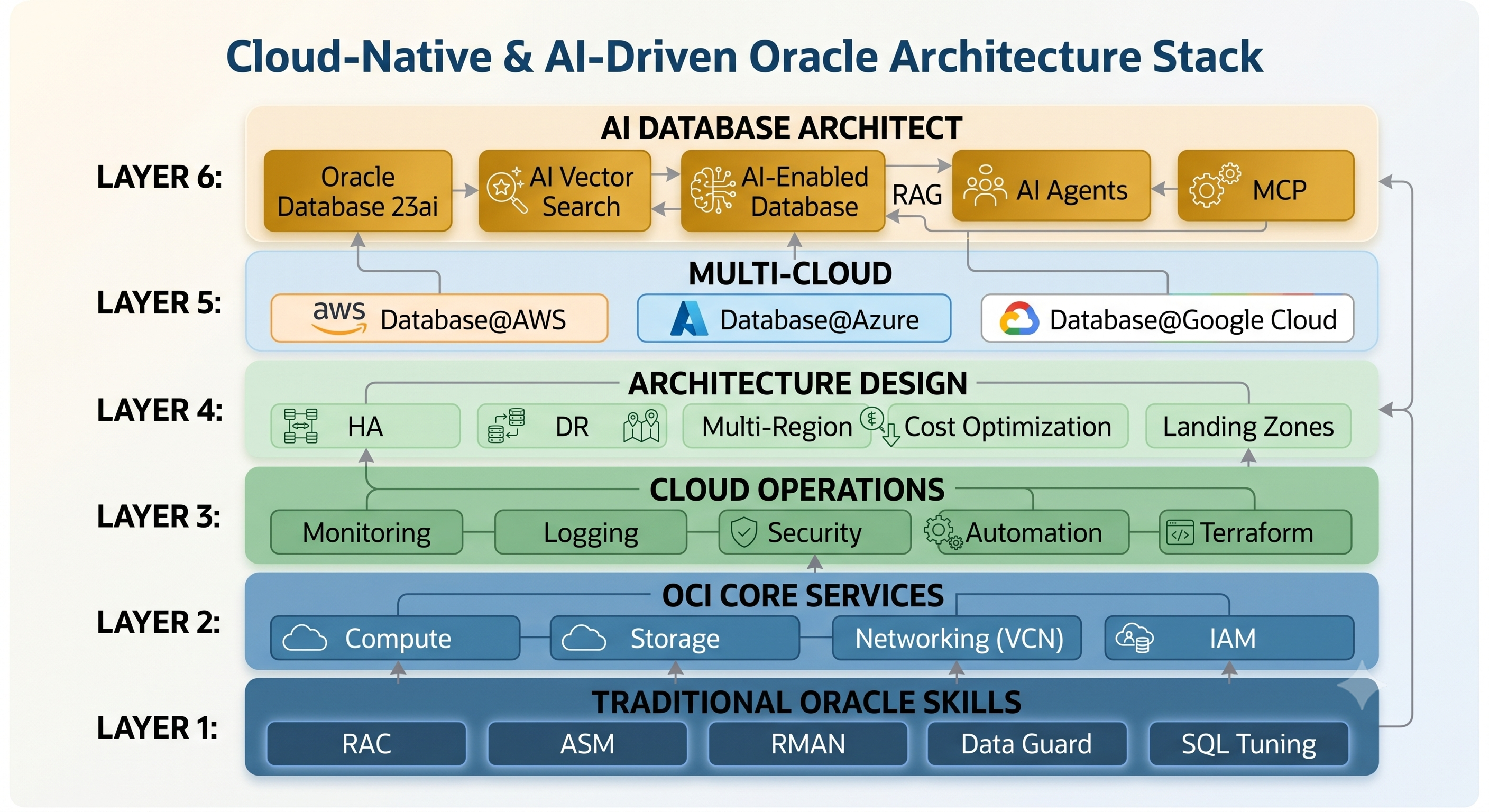
Figure 1 · Oracle DBA → OCI Architect transformation architecture
Layer 1 — Traditional Oracle Skills
Your foundation, and it's a strong one. RAC taught you clustering and split-brain. ASM taught you storage abstraction before it was fashionable. Data Guard taught you replication and failover. RMAN taught you recovery discipline. Every one of these maps to a cloud concept — you are not starting at zero, you are starting at the most useful possible place.
Layer 2 — OCI Core Services
The new primitives. Compute shapes replace your servers, Block/Object/File storage replace your SAN, the VCN replaces your data-centre network, and IAM replaces your tangle of OS users and Oracle roles. This is where most DBAs first feel disoriented — and where OCI Networking demands the most humility.
Layer 3 — Cloud Operations
Now you make the system observable and reproducible. Monitoring and logging replace your hand-written scripts; Terraform turns infrastructure into reviewable code. The mental shift here is from "I configured it" to "the code configured it, and the code is the truth."
Layer 4 — Architecture Design
This is the altitude change. You stop deploying components and start composing them into systems that meet HA, DR, multi-region, and cost-optimisation goals. Your DBA instinct for "how does this fail?" is worth more here than anywhere else.
Layer 5 — Multi-Cloud
The same Oracle database now runs inside AWS, Azure, and Google Cloud via Oracle Database@AWS, Oracle Database@Azure, and Oracle Database@Google Cloud — frequently on Exadata hardware, with RAC and 23ai intact. The architect who can reason across two clouds at once is rare and richly paid.
Layer 6 — AI Database Architect
The top of the stack and the newest. With 23ai bringing AI Vector Search into the engine, the database becomes the place where RAG pipelines, AI agents, and emerging standards like MCP meet enterprise data. This is the role most DBAs are uniquely qualified for and least aware exists.
05 · The Skills Gap Analysis
The good news for a working DBA: very little of this is genuinely foreign. Most of the journey is re-labelling concepts you already own. The table below outlines exactly how those skills align.
| Current DBA skill | OCI / cloud equivalent | Difficulty | Learning time | Business impact |
|---|---|---|---|---|
| RAC | HA design across fault & availability domains; Exadata Cloud Service | Medium | 2–3 weeks | High — uptime & SLAs |
| ASM | Block / Object / File storage tiers & performance/cost selection | Low | 1 week | Medium — cost & durability |
| RMAN | Backup policy, Object Storage retention, immutability, ZDM migration | Low | 1 week | High — recoverability |
| Data Guard | Multi-region DR, Autonomous DB standby, RTO/RPO design | Medium | 2 weeks | High — resilience |
| SQL performance | Workload sizing, compute shapes, Exadata smart scan economics | Low | 1 week | Medium — efficiency |
| Backup strategies | Policy-as-code, lifecycle rules, cross-region copy | Low | 3–5 days | Medium — compliance |
| (none — net new) | OCI Networking — VCN, subnets, route tables, gateways, peering | High | 4–6 weeks | Critical — the real gate |
| (none — net new) | IAM, policies, compartments, security zones | Medium | 2 weeks | Critical — security |
| (none — net new) | Terraform / IaC & CI/CD for infrastructure | Medium | 3 weeks | High — scale & speed |
Notice where the difficulty concentrates. Everything you already know transfers in days or a couple of weeks. The genuinely hard, net-new work is networking, IAM, and infrastructure-as-code. That's the gap. Plan your time accordingly — most people under-invest in networking and it shows in every design review.
06 · The OCI Learning Blueprint
This is not a "study for the exam" plan. It is a "become dangerous in production" plan, sequenced so each month earns the right to the next. The order matters more than the speed.
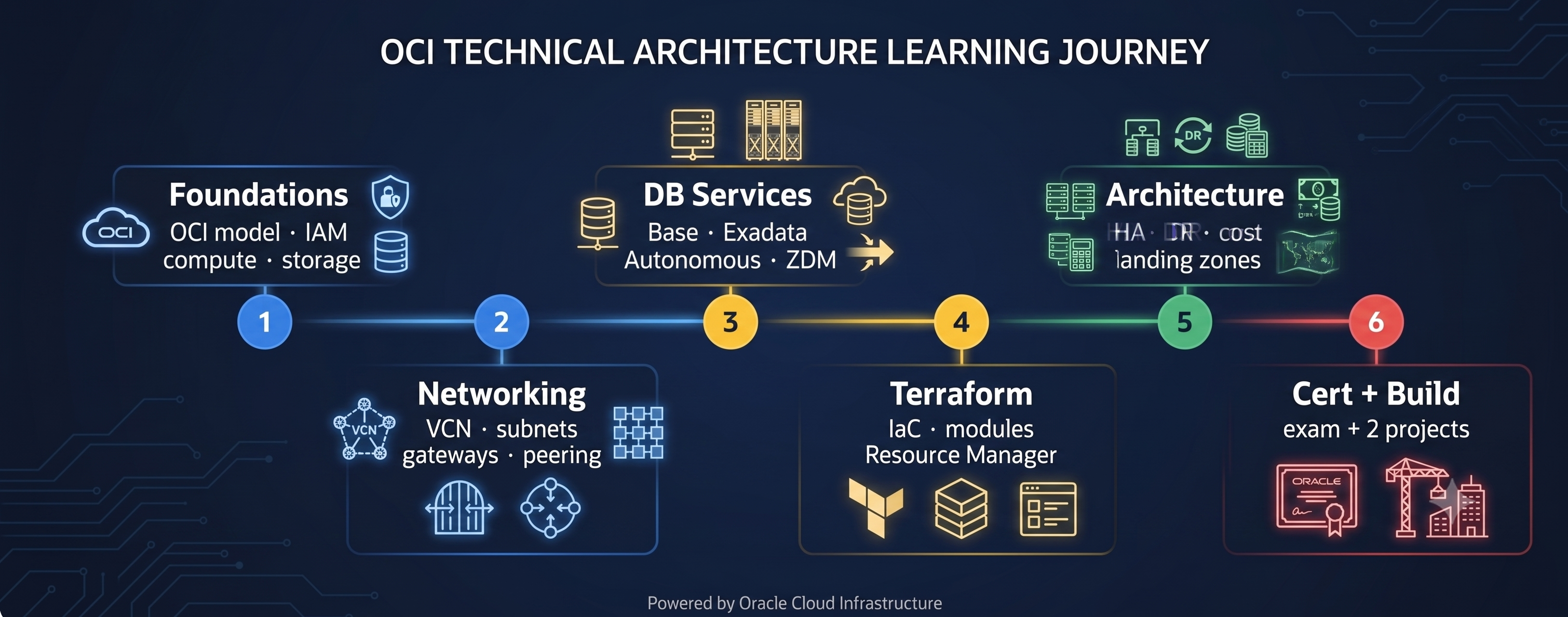
Figure 3 · OCI career transformation roadmap — six-month sequence
Month 1 — OCI Foundations
Learn the OCI mental model: regions, availability and fault domains, compartments, tenancy. Stand up free-tier compute and storage by hand. Goal: stop translating everything back to on-prem in your head.
Month 2 — Networking
The make-or-break month. Build a VCN from scratch: subnets, route tables, security lists, internet/NAT/service gateways, and VCN peering. Break it, fix it, draw it. If you only deeply master one new thing, make it this.
Month 3 — Database Services
Now your home turf meets the cloud: Base Database, Exadata Cloud Service, and Autonomous Database. Migrate a real database with ZDM. This is where your existing expertise compounds fastest.
Month 4 — Terraform
Re-create everything from months 1–3 as code. Write modules, use Resource Manager, put it in a repo. Infrastructure you can't reproduce from code isn't an architecture — it's a pet.
Month 5 — Architecture
Compose the pieces into designs: multi-AD HA, multi-region DR, cost-optimised topologies, and a basic landing zone. Start defending decisions out loud, as you would in a review.
Month 6 — Certification + Projects
Now — and only now — sit the certification, because it will confirm what you already built rather than substitute for it. Ship two portfolio projects you can talk about for thirty minutes each.
07 · Real Enterprise Scenario
A transformation case study
Background
A mid-size financial-services firm running a long-standing on-prem Oracle estate: a four-node RAC cluster on aging hardware, ASM, Data Guard to a secondary site, nightly RMAN to tape. Their senior DBA — we'll keep him close to Raj — had run it flawlessly for years.
Problem
The hardware refresh quote was painful, the secondary site lease was up, and the board had mandated "cloud-first." Leadership assumed they'd hire an external cloud architect and have the DBA "support" them. He saw the writing on the wall.
Migration initiative
The target: Exadata Cloud Service on OCI in-region, Autonomous Database for a reporting workload, multi-region DR, and Object Storage for immutable backups — all defined in Terraform.
Skill gaps
His database knowledge was an asset from day one. The gaps were exactly the predictable three: OCI networking, IAM/compartment design, and infrastructure-as-code. Architecture thinking he half-had already, from years of designing HA and DR by hand.
Training process
He followed essentially the six-month blueprint above, with networking deliberately front-loaded and ZDM practised on a real copy of production. Crucially, he built before he certified.
Projects
Two real artifacts: a Terraform landing zone for the firm's OCI tenancy, and a documented ZDM migration runbook for the core RAC database. Both became internal standards.
Outcome
He didn't "support" an external architect. He became the architect of record for the migration, and the external hire was scoped down to an advisory review. He now owns the cloud design standards for the estate.
Salary growth
His compensation moved from a senior-DBA band into an architect band — in his market, a step-change of well over 50%, before the multi-cloud and AI work that's now on his plate.
Lessons learned
Three, in his words: networking was harder and more important than he expected; the certification mattered far less than the two projects; and his "old" DBA instincts for failure and recovery turned out to be the most senior thing in every architecture review.
08 · The Future
Why Database 23ai changes everything
For most of its history, the database stored data and the intelligence lived elsewhere. Oracle Database 23ai inverts that. It brings AI to where the data already lives instead of shipping data out to where the AI runs — and for an architect, that reshapes the entire diagram.
AI Vector Search
Vectors — numerical representations of meaning — now live as a native type inside the database, searchable alongside your relational data in the same SQL. Semantic search over documents, images, and unstructured content happens without copying data into a separate vector store. One fewer system to secure, sync, and explain to auditors.
RAG
Retrieval-Augmented Generation becomes a database-resident pattern: an LLM's answers are grounded in your private business data, retrieved by vector search, without that data ever leaving the governed boundary. The architect's job is designing that retrieval path safely.
AI agents & MCP
As agents begin to act on enterprise data, and standards like the Model Context Protocol (MCP) emerge to connect models to tools and data, the database becomes the trusted source agents reach into. Someone has to design who-can-touch-what — and that someone reasons like a DBA.
Autonomous Database
Self-driving, self-securing, self-repairing. It doesn't remove the architect; it elevates the work from "keep it running" to "design what it should do." Routine toil shrinks; design judgment grows in value.
Future architects will need both database and AI fluency. DBAs already own the harder, less-fashionable half — data, consistency, security, recovery. The AI half is the part you can learn.
09 · Technical Architecture Deep Dive
The modern Oracle enterprise stack
Here is what a 2026-era Oracle enterprise architecture actually looks like when 23ai sits at its centre. Follow the request from the user all the way down to the AI layer and back.
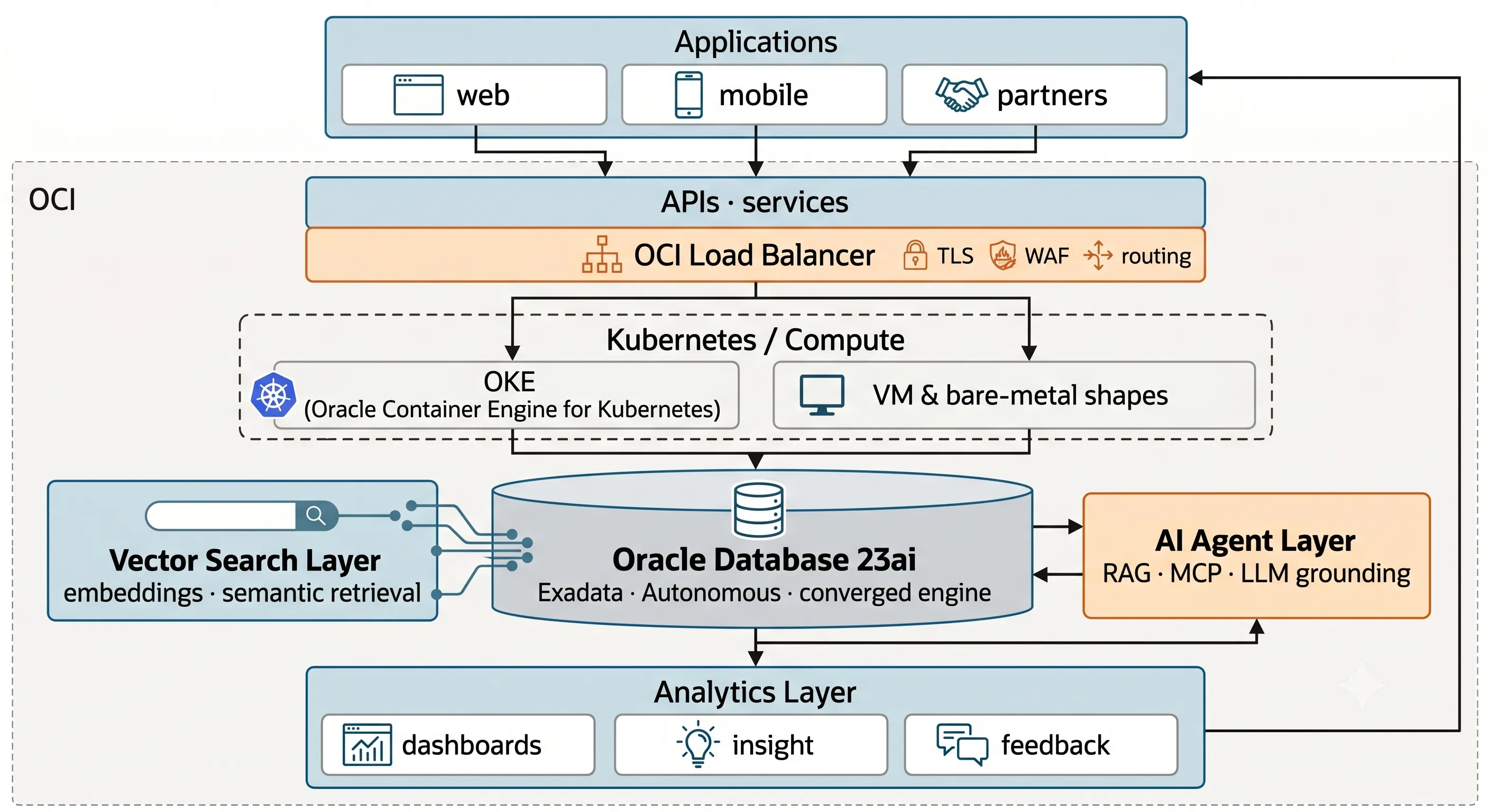
Figure 2 · Modern Oracle enterprise architecture (2026) with Database 23ai
Data flow
A user request enters through the OCI Load Balancer, which terminates TLS and routes to application services running on Kubernetes (OKE) or compute. The application queries Oracle Database 23ai — and here's the difference from 2020: that same query can pull relational rows and perform a vector similarity search in one engine. The vector layer retrieves semantically relevant context; the AI agent layer feeds it to an LLM via RAG so answers are grounded in real, governed data; and the analytics layer closes the loop with insight and feedback.
Business value
Fewer moving parts means a smaller attack surface, simpler compliance, and lower latency — no data shuttling between a database and a bolt-on vector store. For the architect, it means one governed boundary to reason about instead of five. That consolidation is exactly the kind of trade-off a DBA-turned-architect evaluates better than a pure cloud generalist.
10 · Career & Salary Analysis
Numbers vary by market, employer, and how much real architecture you actually do — so treat these as market-informed ranges (total compensation), not promises. The pattern across regions is more reliable than any single figure: each rung up the stack carries a distinct premium, and the largest single jump is from senior DBA to OCI Architect.
| Role | India (₹/yr) | USA (USD/yr) | Middle East (USD/yr)* | Remote / Global* |
|---|---|---|---|---|
| Traditional Oracle DBA | ₹12–25 L | $110–135 K | $45–70 K | $60–95 K |
| OCI Architect | ₹28–55 L | $150–200 K | $70–110 K | $95–150 K |
| Multi-Cloud Architect | ₹45–90 L | $180–230 K | $95–140 K | $130–190 K |
| AI Database Architect | ₹55 L–1 Cr+ | $190–260 K+ | $110–160 K+ | $150–220 K+ |
* Middle East & Remote figures are indicative market estimates; India & USA reflect 2026 public salary data (levels.fyi, Glassdoor, ZipRecruiter).
Figure 4 · The salary growth journey — DBA → AI Database Architect
Commentary. Two things stand out. First, the biggest proportional jump is the first one — DBA to OCI Architect — because it's the step where your title and scope change, not just your tooling. Second, the AI Database Architect bureau is still forming, which means it's under-supplied; early movers with both database depth and AI fluency are setting their own price. In India specifically, public data shows Oracle solution-architect total compensation reaching into the tens of lakhs and beyond at senior levels — a different universe from a maintenance-DBA salary.
11 · Certification Roadmap
A reminder before the table: certifications confirm skill, they don't create it. Sit them after you've built, not instead of building. With that caveat, here is the sensible 2026 path.
| Step | Certification | 2026 exam code | Notes |
|---|---|---|---|
| 1 | OCI Foundations Associate | 1Z0-1085-series | Free entry exam; ~55 questions, lifetime validity. Best first step. |
| 2 | OCI Architect Associate | 1Z0-1072-25 → 1Z0-1072-26 | Core. The -25 version retires 29 May 2026; sit the current version. ~65% to pass. |
| 3 | OCI Architect Professional | 1Z0-997-25 | N-tier, microservices, serverless, HA/DR design. ~70% to pass. |
| 4 | Oracle Database 23ai / AI Vector Search | 23ai-aligned track | Positions you for the AI Database Architect path. |
| 5 | Multi-cloud add-ons (Database@Azure/AWS/GCP) | vendor-aligned | Pursue once you have a real multi-cloud project to anchor it. |
Table 2 · Certification roadmap · verify exact current exam codes on Oracle University before booking — Oracle revises versions annually.
12 · Observations From Real Transformations
Ten patterns I see every cohort:
- Networking is the biggest challenge for DBAs.Not Terraform, not AI — the VCN. Subnets, route tables, and gateways are where confident DBAs go quiet. Front-load it.
- Automation changes daily responsibilities.The midnight-script reflex has to die. If it isn't in code and a pipeline, it isn't done.
- Architecture skills create the largest salary premium.Tools are commoditised. The ability to decide and defend a design is what's scarce and paid for.
- Old DBA instincts shine in design reviews."How does this fail? What's the recovery path?" — DBAs ask the senior questions that cloud generalists skip.
- Certifications without projects fall flat in interviews.A badge opens a screen; a project you can talk about for 30 minutes closes the role.
- The hardest unlearning is "I configured it by hand."Pride in manual mastery becomes a liability in a reproducible-infrastructure world.
- IAM and compartments confuse more people than expected.Security design is half the architect's job and the half DBAs under-rehearse.
- Multi-cloud fluency is rarer than vendors imply.Few people can reason about two clouds at once. Those who can name their price.
- Cost is now an architectural property, not a finance afterthought.Architects who design for cost from day one are trusted with bigger estates.
- The AI Database Architect role is wide open.Most DBAs don't know it exists. The ones who move early define the standards everyone else follows.
13 · Practical Design Rules
Ten rules for the transformation:
- Do not chase certifications before building projects.Build first. Certify to confirm, not to substitute.
- Understand networking before Terraform.You can't automate a topology you don't understand.
- Master OCI before multi-cloud.Depth in one cloud makes the second one fast. Breadth without depth is fragile.
- Learn architecture before AI.An AI layer on a bad architecture is just an expensive bad architecture.
- Reproduce everything from code.If you can't rebuild it from a repo, it's a pet, not an architecture.
- Design for failure first, features second.HA and DR aren't add-ons. They're the spine. Your DBA past makes this natural.
- Treat cost as a first-class requirement.Tag it, model it, defend it. Cost surprises end architect credibility fast.
- Make security a default, not a phase.Compartments, least-privilege IAM, and zones belong in the first draft.
- Keep one foot in the database.Don't abandon your edge. Your data depth is the rarest part of you.
- Document the "why," not just the "what."Architects are judged on decisions. Record the trade-offs you made and rejected.
Why an architecture-first approach works
Most cloud training optimises for passing an exam. The transformation we've described optimises for something harder: being trusted to design production systems. The difference shows up in how the learning is structured.
At ExaGuru, the approach mirrors this article deliberately:
- Real-world labs — you build VCNs, break them, and rebuild them, rather than watching someone else click through a console.
- Migration projects — actual ZDM and Exadata Cloud Service migrations, because that's where DBA depth converts directly into architect credibility.
- Architecture-first learning — design and defence of HA/DR/cost topologies, sequenced after networking and before AI, exactly as the stack demands.
- Industry mentors — people who've run large enterprise Oracle migrations and can tell you why a design is wrong, not just that it is.
- Enterprise scenarios — the work resembles the job, so the portfolio you leave with is the portfolio that gets you hired.
The goal isn't a certificate on a wall. It's the moment in a design review when the room realises the former DBA is the most senior architect at the table.
14 · Conclusion
You already own half the equation
Raj's story doesn't end with the database being taken away from him. It ends with him owning the system the database lives inside — and being paid accordingly. That ending is available to almost every experienced Oracle DBA willing to climb the stack one layer at a time.
The future belongs to professionals who understand both data and architecture. Oracle DBAs already possess half of that equation. OCI, multi-cloud, and AI complete the other half.
The skills that protected your career for a decade are the foundation, not the ceiling. Start with networking. Build before you certify. Keep one foot in the database. And remember that the rarest, most senior question in any cloud architecture review is still the one you've been asking for years: how does this fail, and how do we recover?