01 · The 2 AM Alert
"Security is green. The network is dark."
It is 2:00 AM. Your phone buzzes with a high-severity alert. The core application server in your newly deployed Oracle Cloud Infrastructure (OCI) environment can no longer connect to its dependencies. The application server cannot pull patches from the public internet. It cannot upload backups to OCI Object Storage. It cannot talk to the database sitting in another Virtual Cloud Network (VCN), and the connection to your on-premises data center is completely dark.
You pull up your dashboard. The security team swears everything looks pristine. The Network Security Groups (NSGs) are wide open for these paths. The Subnet Security Lists have explicit stateless and stateful rules allowing the traffic. The firewall team chimes in — they do not see a single packet hitting their appliance.
The instances are up, the applications are running, and the security policies say "green." Yet your packets are vanishing into the ether.
Security Lists and NSGs only grant permission. Route Tables dictate execution. Misconfigured routing drops packets before they ever reach a firewall.
Sharing one route table across public, application, and database tiers is the most common enterprise anti-pattern in OCI networking.
A missing Service Gateway rule can route terabytes of Object Storage traffic through a NAT Gateway — costing latency, throughput, and money.
02 · Where Is the Traffic Actually Going?
In OCI, Route Tables act as the silent, invisible traffic cops of your cloud architecture. Misunderstand them, and you will build fragile, black-holed networks. Understand them deeply, and you can engineer resilient, highly secure, and enterprise-grade topologies.
Security says "allowed." Routing says "where." When routing is wrong, allowed packets still die — silently, at the VNIC, with no firewall log to show for it.
03 · How the OCI Software-Defined Network Evaluates Traffic
Unlike traditional physical networks where hardware routers exchange topology maps using dynamic routing protocols like OSPF or BGP, OCI uses a highly optimized overlay network. Routing decisions are not deferred to a distant core router — they happen locally, at the hypervisor, at line rate.
When a packet leaves a compute instance, OCI looks at the destination IP address and scans the assigned Route Table from top to bottom. It resolves conflicts using Longest Prefix Match — a foundational networking concept where the most specific CIDR route always wins.
Sample Application Subnet Route Table
Table 1 · Typical private application tier route table rules
04 · The Power of Longest Prefix Match
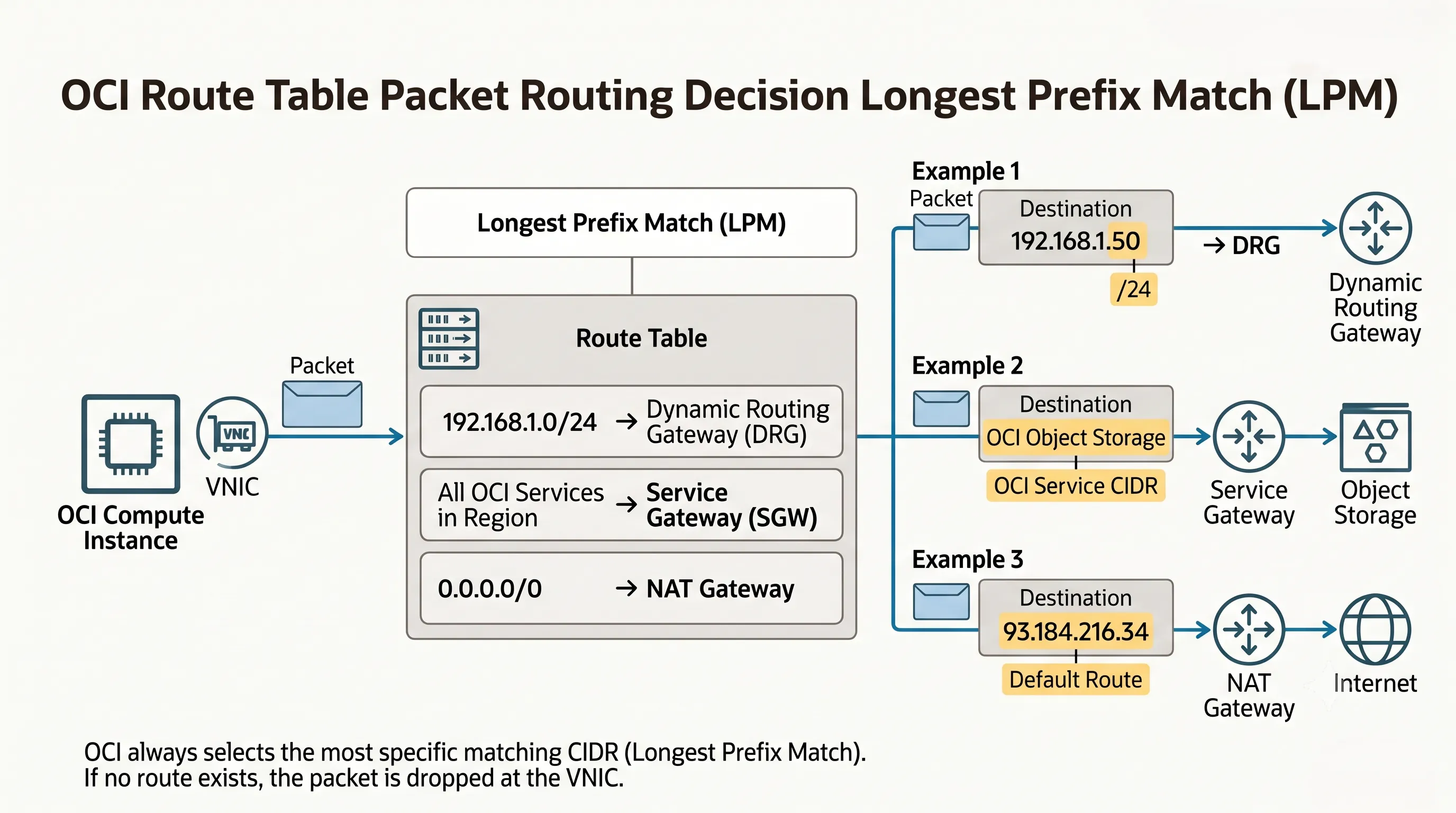
Figure 1 · Longest Prefix Match — how OCI selects the winning route rule
Concrete LPM Scenario
If your compute instance attempts to send a packet to 192.168.1.50, OCI matches both the default route (0.0.0.0/0) and the specific on-premises route (192.168.1.0/24). Because /24 is a longer prefix match than /0, OCI bypasses the NAT Gateway entirely and encapsulates the packet directly toward the Dynamic Routing Gateway (DRG).
Conversely, if the application tries to hit a public API at 93.184.216.34, the only matching rule is the catch-all default route (0.0.0.0/0). The packet is wrapped and dispatched straight to the NAT Gateway.
If a packet's destination IP does not match any CIDR block listed in the route table — and no default 0.0.0.0/0 route exists — the OCI control plane instantly drops the packet at the source VNIC. It won't leave the host. It won't hit a firewall. It simply ceases to exist.
05 · The Architecture Blueprint: Why Subnets Require Dedicated Route Tables
The Shared Default Route Table Anti-Pattern
When you provision a new VCN, OCI automatically generates a single Default Route Table. It is incredibly tempting to map every subnet — public web tier, private application tier, locked-down database tier — to this one table. You add an Internet Gateway route, a NAT Gateway route, and a DRG route, thinking you have created a universal routing engine.
This is a recipe for operational disaster. The operational blast radius of an un-isolated route table layout creates an asymmetric routing loop that can take down unrelated production tiers with a single rule change.
Public vs. Private Subnet Routing Goals
| Subnet Type | Default Route (0.0.0.0/0) | Traffic Direction | Risk if Shared |
|---|---|---|---|
| Public Subnet | Internet Gateway (IGW) | Bidirectional — public IP NAT | Asymmetric loop |
| Private Application | NAT Gateway (NATG) | Outbound-only internet | Inbound exposure |
| Database Tier | No internet route / SGW only | Internal + OCI services only | Blast radius |
A Public Subnet houses resources that must be directly reachable from the outside world — load balancers, public-facing ingress proxies. Their VNICs must map 0.0.0.0/0 to an Internet Gateway for bidirectional public IP resolution.
A Private Subnet houses resources that should never accept direct inbound connections from the open internet. If these instances require outbound internet access for OS updates, they must route 0.0.0.0/0 through a NAT Gateway. If you point 0.0.0.0/0 globally to the IGW, private instances attempt to respond via the IGW — but without public IP mapping, the IGW drops return traffic.
Operational Blast Radius and Agility
Consider an engineer who needs to temporarily route outbound internet traffic from the application tier through an inline Next-Generation Firewall (NGFW) virtual appliance for a compliance audit. If the application tier shares a route table with the database or web tier, modifying that single 0.0.0.0/0 entry instantly alters traffic engineering for every workload across the enterprise network.
By enforcing a strict One Dedicated Route Table per Subnet Tier policy, you cleanly isolate routing domains. You gain the agility to tweak paths, implement transit routing architectures, and swap underlying gateway appliances for specific application profiles without risking cascading production outages.
06 · OCI Gateway Selection: Where Traffic Should Actually Go
| OCI Gateway Type | Traffic Direction | Primary Use Case | Internal vs External Path |
|---|---|---|---|
| Internet Gateway (IGW) | Bidirectional | Public ingress / egress in public subnets | Public internet space |
| NAT Gateway (NATG) | Outbound only | Private subnet OS patches, repo pulls | Public internet space |
| Service Gateway (SGW) | Inbound to Oracle services | Object Storage, Autonomous DB, KMS | Internal Oracle backbone fabric |
| Dynamic Routing Gateway (DRG) | Multi-directional | Cross-VCN, on-premises hybrid, transit hub | Encapsulated transit hub |
Table 2 · OCI gateway comparison matrix for route table next-hop selection
1. Internet Gateway (IGW)
An OCI Public Subnet requires a 0.0.0.0/0 route rule pointing directly to an Internet Gateway. This architecture enables bidirectional network address translation (NAT) between the resource's private IP and its assigned OCI public IP. Use exclusively for public-facing resources in public subnets.
2. NAT Gateway
A NAT Gateway allows instances in a private subnet to securely initiate outbound connections to the internet while completely blocking inbound connection attempts. It scales automatically and handles thousands of concurrent stateful connections. Never use it for OCI service traffic that should traverse the Service Gateway.
3. Service Gateway (SGW)
The Service Gateway is one of the most underutilized efficiency tools in OCI. Instead of routing Object Storage traffic through a NAT Gateway — exposing data to the public internet and incurring performance bottlenecks — the SGW redirects packets over Oracle's internal backbone fabric. Traffic never traverses the public internet, maximizing security and throughput while bypassing egress data charges.
4. Dynamic Routing Gateway (DRG)
The DRG acts as a highly advanced virtual modular transit router for connections extending beyond the local VCN — hybrid on-premises connectivity via IPSec VPN or FastConnect, and cross-VCN/cross-region peering topologies. It maintains its own internal attachments and route tables for hub-and-spoke enterprise environments.
07 · Why OCI Route Tables Break Production Environments
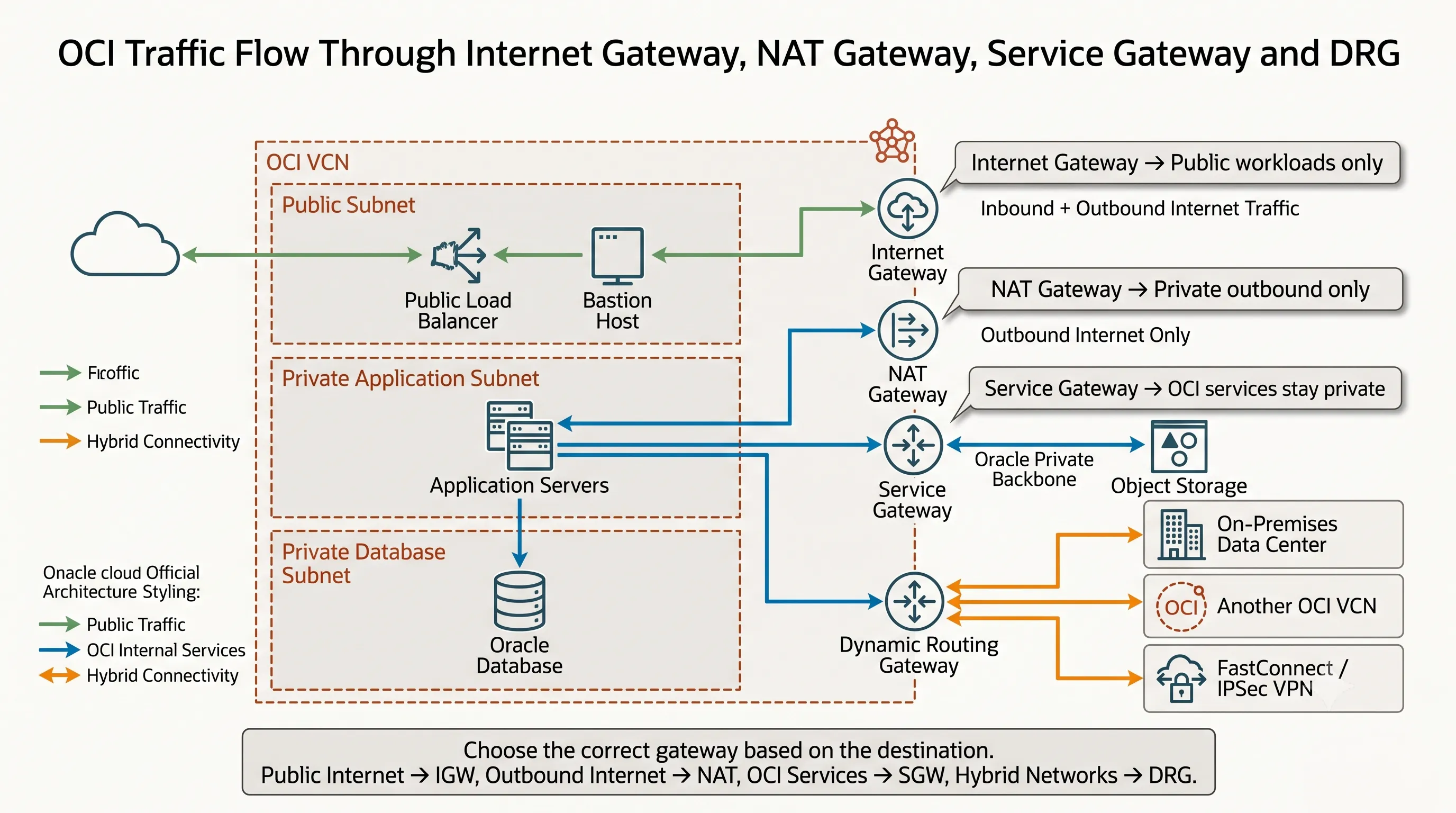
Figure 2 · Common OCI route table failure modes in enterprise deployments
The Service Gateway Bypass (Costly and Slow)
A classic enterprise mistake is forgetting to add the All OCI Services in Region CIDR label to private subnet route tables. A data science application reading multi-terabyte datasets from Object Storage with only a 0.0.0.0/0 → NAT Gateway rule will push terabytes through the public internet routing space and back into OCI via public endpoints.
Result: erratic latency, NAT Gateway throughput limits, and unnecessary data traversal costs. One SGW rule keeps all data on the internal physical backplane.
Asymmetric Routing via Inline NGFW Appliances
Enterprise security teams often mandate that inter-VCN or VCN-to-on-premises traffic pass through a centralized cluster of Next-Generation Firewall (NGFW) virtual appliances in a transit VCN. The outbound path works: spoke → DRG → firewall → on-premises. The outage occurs on the return path.
When the on-premises server replies, the packet enters the DRG. If the DRG's internal routing policies bypass the firewall on the return leg and deliver the packet directly to the spoke VCN instance, the spoke receives an asymmetric reply. The firewall tears down its state entry because it never saw the return handshake — killing subsequent communication.
Overlapping CIDRs and the Trap of LPM
When organizations merge networks or interconnect business units via DRG peering, overlapping IP spaces create LPM conflicts. If your VCN uses 10.0.0.0/16 and you peer with a legacy environment using 10.0.0.0/24, OCI prioritizes local VCN routing over external gateways. Traffic intended for the peer routes internally and dead-ends on a local host with no forwarding knowledge.
Routing failures are often misdiagnosed as security failures. Remember: in OCI, Security Lists and NSGs form a union — if a Security List allows a packet, an NSG restriction cannot block it (and vice versa). Both must permit traffic and a matching route must exist. Fixing NSGs alone will not resolve a black-holed route table.
08 · Oracle's Golden Architecture Blueprint for OCI Route Tables
- Enforce strict subnet isolation.Never share a single route table across different functional layers. Implement dedicated route tables for Public/DMZ, Private Application, and isolated Database tiers.
- Explicitly leverage the Service Gateway.Every private subnet route table should feature a rule for All OCI Services in Region pointing to an SGW next-hop. This eliminates unnecessary public data exposure and egress friction.
- Keep default routes deterministic.A subnet should only ever have a single definitive catch-all 0.0.0.0/0 route. OCI evaluates deterministically by match specificity — not round-robin balancing.
- Consolidate multi-VCN architectures onto the DRG.Move away from legacy Local Peering Gateways (LPGs) and point-to-point meshes. Use a centralized Dynamic Routing Gateway as your unified transit hub with Import/Export Distributions.
- Pre-plan your global IPAM.Map enterprise CIDR allocations before deploying your first workload. Ensure non-overlapping boundaries between OCI regions, VCNs, and on-premises data centers to prevent LPM conflicts.
09 · Six Routing Decisions That Prevent Future Outages
Pin these foundational principles to your engineering board:
- Every packet follows a route table.Security Lists and NSGs only grant permission; route tables dictate execution. No matching route means instant drop at the VNIC boundary.
- One route table must not serve every subnet.Isolate routing domains. Public, application, and database tiers require entirely distinct next-hop logic.
- Public and private workloads require different gateways.Public services need bidirectional IGW access; private outbound internet must use a NAT Gateway.
- Keep OCI service traffic internal.Always route Object Storage and Autonomous Database traffic through a Service Gateway — never through a NAT Gateway to the public internet.
- Longest Prefix Match always wins.OCI processes packets by evaluating the most specific destination CIDR rule. Understand prefix lengths to avoid accidental routing black holes.
- Design routing before applications depend on it.Retrofitting transit routing, NGFW inspection zones, or hybrid connectivity into live production with shared route tables is an operational nightmare. Architect clean isolation from day one.
10 · Conclusion
Mastering OCI routing logic is the ultimate differentiator between an amateur cloud builder and an enterprise-grade systems architect. Security policies can be perfect and firewalls can be invisible — yet packets still vanish when route tables lie.
Understanding how traffic moves inside and outside a single VCN is only half the battle. When your organization grows to dozens of VCNs across multiple global regions, interconnected with dual-provisioned cross-connect lines back to your on-premises core, standard subnet routing tables hand over control to the most powerful, complex, and frequently misunderstood component in the entire Oracle Cloud arsenal.
In our next deep-dive architectural brief, we unpack the ultimate backbone of enterprise cloud networking: The Most Misunderstood OCI Network Resource Is the DRG — hub-and-spoke multi-VCN attachments, dynamic route evaluation policies, and advanced transit-routing architectures.
About the Author
Senior Oracle Cloud Architect — 20+ years of enterprise cloud networking and Oracle infrastructure experience. OCI Cloud Architect Professional certified. Specializes in landing zone design, hybrid connectivity, and production incident resolution for Fortune 500 Oracle estates.