01 · The Default VCN Trap
Every single cloud deployment for Oracle starts off in exactly the same manner. One person logs into Oracle Cloud Infrastructure and selects Network from the menu bar and then selects Virtual Cloud Networks to begin building the core OCI VCN infrastructure. One types in a name, a common CIDR range, such as 10.0.0.0/16, and then clicks create.
As a result, they go about their other business. They set up subnets, create compute instances, install load balancers, and start up databases. The whole idea of the VCN is that it becomes almost like a box ticking exercise before you can get onto the "real" stuff.
Months later, severe operational reality hits.
Maybe the need to set up a new production environment arises now. In addition, a project related to disaster recovery suddenly gets approval. The need to isolate a newly established payment gateway or establish a FastConnect connection to a data center is suddenly raised by your security team. Another business group suddenly sets up their cloud tenancy and requires peering with yours.
At that exact moment, your original, default network layout becomes a massive technical liability.
The engineers come to know that their cloud CIDR blocks have overlapping issues with the corporate office network. They come to realize that their subnets were too small to handle the quick expansion of microservices. In the end, they come to know that their routing footprints are spaghetti.
Most people set up a network architecture right away, yet surprisingly few engineers actually realize how critical this architecture is from an architectural point of view. It's not only about a network architecture existing in isolation. Rather, it's about a network architecture being your basic blueprint for all aspects of your cloud deployment.
02 · What Exactly Is a Virtual Cloud Network?
Virtual Cloud Network (VCN) is basically a software-defined network that operates in Oracle Cloud Infrastructure. Basically, this is your private cloud as represented in the software environment. It ensures full isolation from other networks, including other tenants' networks and other VCNs in your tenancy, unless routing connectivity is configured.
One thing that you should not fall into is thinking about this cloud component in the way you think about LAN or hardware VLAN. In a traditional physical data center, a network is defined by the actual wires, physical switches, and edge routers. You might actually have to make physical cable re-patches or work with static hardware interfaces if you need scaling or pathing changes.
On the contrary, modern OCI VCN infrastructure is completely built using the software virtualization layer. It operates natively at the regional level. That is why geographic location makes your VCN span across all Availability Domains (ADs) in your OCI region, no matter whether you operate in a one-AD region such as San Jose or a multi-AD region like Ashburn.
Consequently, the VCN acts as the structural foundation for everything built inside your cloud environment. When you instantiate a network, you are establishing the ultimate system boundary for:
Determining how resources identify themselves and talk to one another.
Defining the exact paths data takes when moving between instances, the internet, or on-premises systems.
Implementing stateful and stateless firewalls directly at the network layer.
Shaping how private and public hostnames resolve across infrastructure components.
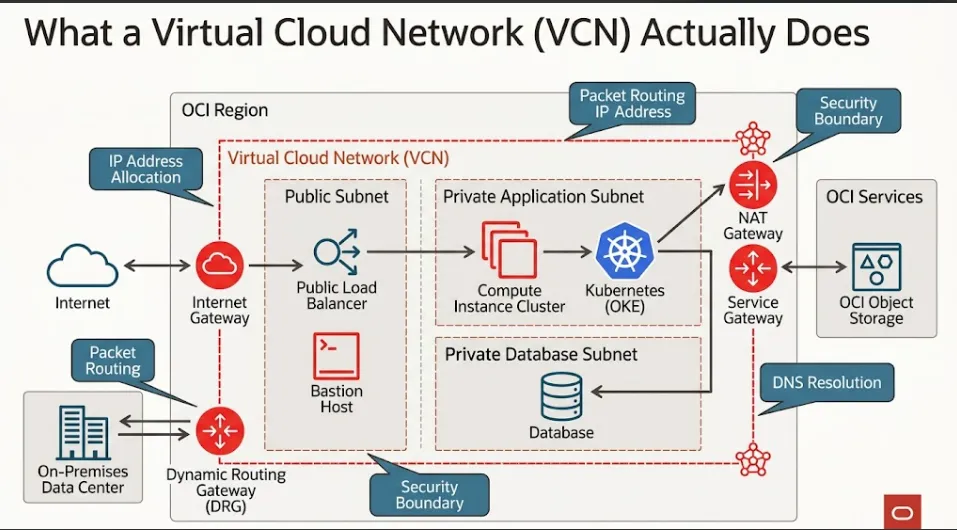
Figure 1 · The VCN as the structural foundation of your OCI environment
03 · Why Your OCI VCN Architecture Design Bedrock Matters
When you click "Create VCN," you are not just making a basic sandbox for virtual machines. Instead, you are setting immutable constraints. While Oracle allows you to add secondary CIDR blocks to an existing VCN later on, the primary block and the structural breakdown of your regional subnets form your absolute bedrock.
If this bedrock is structurally flawed, every architectural layer built on top of it becomes inherently unstable. This includes everything from Kubernetes cluster networking to database replication fabrics. If you fail to treat the network as an active architectural component, you will inevitably find yourself rebuilding it under the intense pressure of a production migration deadline.
For additional baseline concepts, read our comprehensive Guide to OCI Landing Zones to see how these environments anchor corporate applications.
04 · Why Does OCI Start With Networking Before Anything Else?
You can't have a compute instance within OCI without specifying the subnet it should reside in. In turn, you can't create a subnet without having a parent VCN. Oracle imposes a mandatory approach to networking since cloud computing is essentially the matter of distributed systems.
In the absence of a structured network layer, objects will have no identity, proper security perimeter, and means of interaction between each other. Thus, the VCN creates an initial environment for your cloud objects to operate in.
When networking becomes an afterthought
Imagine how the situation looks when networking becomes secondary to the process. A development team requires the fast deployment of an application. Instead of planning everything properly, the team creates an impromptu VCN with some random IP addresses range and puts all objects into a single public subnet with permissive security rules.
While this approach functions fine for a brief proof of concept, the structural gaps become obvious when transitioning to enterprise production:
| Failure mode | What goes wrong | Severity |
|---|---|---|
| Resource Placement Errors | Databases are exposed directly to the public internet because there are no dedicated private subnets. | Critical |
| IP Exhaustion | A massive subnet is completely consumed by ephemeral container instances, leaving zero room for dedicated database clusters or secondary load balancers. | Critical |
| Connectivity Deadlocks | On-premises network monitoring systems cannot reach the cloud resources because the VCN uses an identical IP space to the main corporate data center. | Critical |
Since OCI insists on network architecture being established first, you have no choice but to identify your architecture boundaries upfront. This means that you need to address important issues before even considering investing any money in the computational capabilities. How will those resources communicate with each other? Who should be able to communicate with them externally? Where will the data go in case of failure?
05 · Why Do So Many Teams Regret Their CIDR Choice?
The choice of a Classless Inter-Domain Routing (CIDR) block is the single most common point of failure in cloud network design. Many engineers, accustomed to home labs or isolated development environments, default to picking standard blocks like 10.0.0.0/16 or 192.168.0.0/16. It seems harmless. A /16 network gives you 65,536 IP addresses, which feels like plenty of room for growth.
However, the real issue is rarely about running out of individual IPs within that single VCN. Rather, it is entirely about where those IPs can actually route.
The moment you want to connect that VCN to your corporate data center via an IPSec VPN or a FastConnect circuit, you hit a brick wall. If your on-premises data center already uses portions of that exact same 10.0.0.0/16 range, you will face an immediate routing conflict. Routers cannot determine whether an IP address like 10.0.1.50 lives in your cloud tenancy or on a physical rack in your corporate headquarters.
To bypass this problem, teams frequently resort to complex, fragile workarounds like Network Address Translation (NAT) mesh architectures. This unfortunate quick-fix adds latency, complicates troubleshooting, and introduces dangerous single points of failure into the packet pathway.
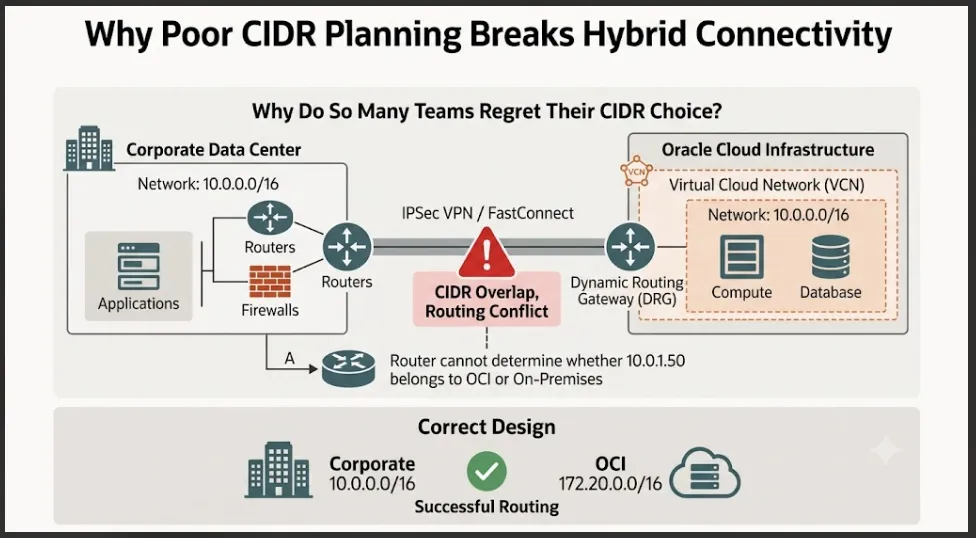
Figure 2 · CIDR overlap — the routing conflict that stops hybrid connectivity cold
06 · Why CIDR Layout Problems Are Expensive to Fix
If you discover your CIDR choice is broken after your applications are live, fixing it is a complete nightmare. Changing a foundational IP strategy is not a simple configuration file change. Instead, it requires a complete operational re-architecture.
To migrate to a non-overlapping CIDR block, your team typically has to complete the following track:
- Build an entirely new VCN side-by-side with the old one.Stand up a parallel network with correct address space before touching production.
- Recreate all subnets, route tables, security lists, and gateways.Every network primitive must be rebuilt from scratch in the new VCN.
- Deploy brand-new compute instances and migrate application data over.Workloads cannot simply be moved — they must be redeployed or migrated with downtime planning.
- Schedule extended maintenance windows to swap DNS records and database connection strings.Every downstream dependency that references an IP or hostname must be updated.
This remediation exercise can easily cost hundreds of thousands of dollars in engineering hours and operational downtime. All of this waste happens because of a decision made in five seconds during initial setup.
07 · Scale Mapping: How Large Should Your VCN Actually Be?
When designing a production-ready OCI VCN architecture, you must balance two competing priorities. You need enough address space to support future scaling, but you cannot take so much space that you deplete your organization's available private IP pool.
Enterprise networking teams protect their private IP space (RFC 1918 blocks) with extreme care. If you ask your network administrator for a massive /16 block for every small business project, your request will quickly be denied.
How do you find the right balance? You can plan efficiently around workloads, environments, and architecture archetypes by utilizing standard sizing tiers.
Accounting for Reserved Platform IP Addresses
When calculating your network sizes, remember that OCI reserves the first two IP addresses and the last address in each subnet for internal networking functionality. This includes the subnet default gateway, the OCI-provided DNS server, and the network broadcast address. If you create a tiny /28 subnet for testing, you immediately lose 3 of your 16 available addresses to the platform infrastructure.
Consequently, it is recommended that you evaluate your short-term scale-up needs and then multiply this number by four. Such a margin will cover any future needs of blue-green deployments, container network pods, and second VNICs. After arriving at this figure, choose the smallest possible standard CIDR block that can accommodate this figure.
Short-term IP need × 4 → then pick the smallest standard CIDR that fits. Always account for 3 reserved IPs per subnet. Coordinate with your corporate networking team before requesting address space.
08 · Should You Create One VCN or Several?
One of the most frequent debates among cloud architects is whether to place an entire infrastructure into a single, massive VCN or distribute it across multiple, smaller VCNs.
The Single VCN Approach
Placing everything into one single network is straightforward. Communication between different tiers is simple because all subnets can route to each other by default via the internal VCN local routing table.
| Advantages | Disadvantages |
|---|---|
| Lower initial complexity, fewer routing tables to manage, simplified DNS configuration, and zero peering costs. | Broad blast radius. A configuration error in a security list or an overly permissive route table entry can instantly expose your core production database to a development subnet. Fine-grained IAM policy enforcement is much harder. |
The Multi-VCN Approach
A multi-VCN architecture treats VCNs as hard isolation boundaries. For example, you might choose to build one VCN for Production, one for Non-Production, and one for Shared Services like monitoring, logging, and identity management.
| Advantages | Disadvantages |
|---|---|
| Zero blast radius spillover between environments. Production networks are completely separated from testing labs, making security boundaries ironclad. | Increased management overhead. You must explicitly manage transit routing, implement Dynamic Routing Gateways (DRGs), configure peering attachments, and resolve cross-VCN DNS challenges. |
The Layout Mistake Most Organizations Make
Most enterprises hang around the single VCN architecture way too long. They start off in OCI with one workload that goes into one VCN. For each additional project, they just add subnets to the existing VCN.
Ultimately, such an approach leads to a completely unmanageable security footprint. If there is a developer writing code within a development subnet that by accident gets access to a production database due to the common VCN perimeter, by the time they understand that they should have been isolated, their systems are too inter-connected to decouple.
09 · Technical Indicators: When Does a Single VCN Stop Being Enough?
How do you know when you have outgrown a single VCN setup? There are clear technical indicators that tell you it is time to break apart your network into a more mature model.
- Production vs. Non-Production CoexistenceIf your development teams are running heavy load tests, automated vulnerability scanning tools, or experimental deployments inside the same VCN that routes your production customer traffic, you are playing with fire. One rogue script or misconfigured routing loop can degrade performance across your entire production environment. Production workloads should always live in their own dedicated VCN.
- Regulatory and Compliance MandatesIf your business processes credit card transactions (PCI-DSS), handles sensitive healthcare records (HIPAA), or operates under strict data sovereignty laws, you must prove isolation to outside auditors. Auditing a single VCN with hundreds of mixed resources is painful. Conversely, auditing a dedicated, minimal VCN reserved solely for compliant workloads is significantly cleaner.
- Distinct Organizational ControlWhen different business units manage their own infrastructure budgets and resource lifecycles, giving them subnets inside a shared VCN creates major operational bottlenecks. If Team A wants to modify an Internet Gateway configuration, they risk disrupting Team B's traffic. Separate business units should operate in separate VCNs, wrapped in their own OCI Compartments, and bound together using clear, audited policy controls.
10 · Deploying a Hub-and-Spoke OCI VCN Architecture
With the help of patterns designed by Oracle in modern landing zones, we get an expected secure and highly scalable network structure which is known as "The Hub-and-Spoke Network Architecture." In this architecture, there is no relation between each VCN with all other VCNs; however, the central VCN, known as "Hub," will manage all ingress/egress traffic. Applications/environs will exist in VCNs known as "Spoke."
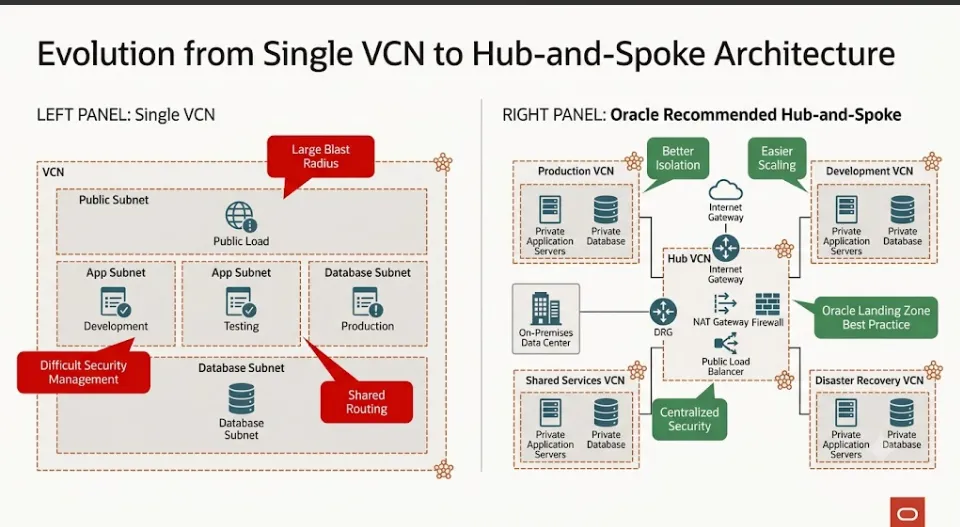
Figure 3 · Hub-and-Spoke OCI VCN architecture — centralized connectivity with isolated spokes
Core Recommended Design Principles
Connect your on-premises Fast Connect or VPN directly to the Hub VCN's Dynamic Routing Gateway (DRG). The spokes reach back to your corporate network transitively through this Hub.
Place your public load balancers, next-generation firewalls, and API gateways inside the Hub VCN. Keep your spoke VCNs entirely private, with no direct Internet Gateways attached.
Utilize OCI's upgraded DRG capabilities. A single DRG can cross-attach multiple VCNs within a tenancy and apply advanced routing policies to control exactly which spokes can talk to each other.
Move away from relying solely on Subnet Security Lists. Use Network Security Groups (NSGs) to apply security rules directly to individual virtual network interface cards (VNICs), regardless of which subnet they reside in. For deeper security insights, look over our Enterprise Cloud IAM Best Practices documentation.
11 · The Four Infrastructure Layers Your VCN Decision Impacts
When you configure your network layout, you are directly shaping the behavior of four distinct infrastructure layers that sit on top of it. If your VCN design is flawed, these four components will inherit those flaws:
| Layer | How VCN design affects it |
|---|---|
| Subnets | Subnets inherit the address space of the parent VCN. If your initial VCN CIDR is too restrictive, your subnets will be cramped, limiting your ability to scale load balancers or deploy node-heavy Kubernetes clusters. |
| Route Tables | Each subnet uses a route table to direct traffic out of the VCN. A fragmented multi-VCN layout without a clear hub strategy results in a massive inventory of redundant, manual route rules that are difficult to track. |
| Security Controls | Security Lists operate at the subnet level, while NSGs operate at the resource level. Both depend on the network paths permitted by the VCN's boundaries. A messy VCN layout leads to bloated firewall policies. |
| Hybrid Connectivity | Your VCN is the cloud endpoint for your corporate WAN. If the VCN's IP blocks are not carefully planned from day one, your on-premises edge routers will reject your cloud advertisements. |
12 · Summary: 6 VCN Decisions That Are Hard to Undo
If you take nothing else away from this architectural deep dive, keep these six foundational realities in mind before your next OCI deployment:
- The VCN is an architecture decision, not something to configure.Viewing it as a straightforward process will mean that you are postponing the costly effort of redesigning to yourself later on down the line. Make sure you plan out your network topology first.
- Plan your CIDR blocks with future growth in mind rather than just the current requirements.Coordinate with your company's networking department before choosing an IP address block. Avoid any overlaps between your cloud-based and on-premises networks.
- The default should be private infrastructure.Do not grant public internet connectivity to subnets unless you really need it. Keep your databases, applications, and backend engines in the private subnet and use NAT or Service Gateway for outbound connectivity.
- Embrace the multi-VCN mindset early.Do not wait for a major production incident to separate your development platforms from your live services. Build an environment boundary structure as soon as you move beyond basic experimentation.
- Adopt Hub-and-Spoke for enterprise scale.If you anticipate managing more than three distinct application environments or connecting to a physical data center, build a Hub-and-Spoke network using OCI's Dynamic Routing Gateway.
- Every future decision depends on today's VCN.The security, performance, and management efficiency of your entire OCI tenancy are directly tethered to the network structure you establish on day one. Design your network with the assumption that it will succeed, scale, and endure for years to come.
The VCN you create in five minutes on day one is the architecture your entire estate inherits for years. Plan it like one.