Master Multi-Cloud Networking
AWS · Azure · GCP
Learn each enterprise networking concept once — then build it across all three clouds. Live instructor-led sessions, hands-on labs every week, and capstone projects you defend.
Our Alumni Work At 50+ Top Companies
Built for Network Engineers Going Multi-Cloud
Concept-First
Learn each enterprise idea once — implement in AWS, Azure, and GCP in the same module.
100% Hands-On
Weekly labs and mini-projects — segmented networks, hybrid VPN, transit hubs, landing zones.
Placement Support
Mock interviews, architect-grade CV, and hiring network access.
Capstone Defence
Each level ends with a real architecture you design, build, and defend.
Week-by-Week, Not Cloud-by-Cloud
Every concept is taught once, then built in AWS, Azure, and GCP side by side. Explore both levels below.
Week 1 — Foundations
Networking Refresher for the Cloud
OSI & TCP/IP recap · encapsulation · MAC vs IP · ARP · TCP handshake, ports, MSS/MTU · packet walk end to end
IP Addressing & CIDR Design
RFC1918 · CIDR & VLSM maths · subnet sizing · non-overlapping enterprise address plan · reserved IPs per cloud
Routing, NAT & DNS Fundamentals
Routing table logic · longest-prefix match · static vs dynamic · default route · NAT vs PAT · DNS resolution flow & record types
Cloud Foundations & Account Hierarchy
Service & deployment models · Region / AZ / Zone · global vs regional constructs · tenancy hierarchy · shared responsibility model
Console, CLI & First Workload
Console navigation · CLI/SDK auth models · IAM basics for network engineers · launching a VM and proving reachability
Week 2 — Foundations
Virtual Networks - VPC / VNet / VPC
Virtual network scope & isolation · regional vs global behaviour · default vs custom networks · CIDR expansion limits
Subnets & Tiered Segmentation
Public vs private subnets · tier separation (web/app/data) · zonal placement & HA · subnet sizing trade-offs
Route Tables & Traffic Steering
System vs custom routes · route priority & longest prefix · default route behaviour · next-hop types
Network Security Controls
Stateful vs stateless filtering · allow-only vs deny rules · tier-to-tier rules · least-privilege network policy
Lab Day - Segmented 3-Tier Build
Consolidation lab: full segmented network built end to end and validated in all three clouds
Week 3 — Foundations
Internet Edge & Egress Control
Ingress vs egress paths · public IP models · SNAT behaviour · NAT sizing, ports & cost · egress-only patterns
DNS in the Cloud
Public vs private zones · split-horizon design · record types & TTL · resolver behaviour inside a VPC/VNet
Load Balancing Foundations (L4)
L4 load balancing · health checks · connection distribution · cross-zone behaviour · preserving client IP
Load Balancing Foundations (L7) & TLS
L7 routing, host/path rules · TLS termination vs passthrough · certificate handling · sticky sessions
Lab Day - Publish an Application
Consolidation lab: internet-facing application with LB, TLS and DNS name across three clouds
Week 4 — Foundations
Network Peering & Shared Networking
Peering semantics · non-transitivity · overlapping CIDR failure modes · shared / centralised network models
Hybrid Connectivity - Site-to-Site VPN
IPsec IKEv2 basics · route-based vs policy-based · redundant tunnels · BGP over VPN · on-prem CPE view
Dedicated Connectivity & Private Service Access
Dedicated circuits, virtual interfaces & path diversity · private access to managed services · endpoint policies
Observability & Troubleshooting
Flow logs & what they do/do not show · metrics and dashboards · systematic reachability troubleshooting method
Infrastructure as Code Primer
Why network config belongs in code · provider/resource model · state · reusable network module structure
Week 5 — Capstone Week (L100)
Capstone Briefing & Design Workshop
Scenario: mid-size firm, one data centre, two public clouds. Requirements gathering, CIDR/ASN plan, design review
Capstone Build - Networks & Segmentation
Implement the virtual networks, subnets, routing and security controls defined in the design
Capstone Build - Connectivity & Delivery
Implement hybrid VPN, private service access, DNS resolution and load-balanced application delivery
Troubleshooting Drill & Runbook
Instructor injects faults across routing, security rules, NAT and DNS; learners diagnose and document
Assessment & Design Presentation
Written knowledge test · hands-on validation · each learner defends their architecture
Week 6 — Architecture & Security
BGP for Cloud Architects
BGP session types · attributes: AS-path, LOCAL_PREF, MED, communities · prepending · prefix filtering · ECMP
AWS Transit Architecture
Hub-and-spoke transit · attachment types · multiple route tables for segmentation · TGW peering & inter-region
Azure Transit Architecture
Hub-spoke vs Virtual WAN · UDR at scale · gateway transit · routing intent & secured hubs
GCP Transit & Shared Networking
Global VPC advantages · NCC hubs and spokes · Shared VPC host/service projects · VPC Service Controls intro
Comparative Design Clinic - Transit
Side-by-side comparison: scale limits, route quotas, segmentation model, cost and operational complexity
Week 7 — Architecture & Security
Advanced DNS & Traffic Management
Geo / latency / weighted / failover routing · health-based steering · DNSSEC · hybrid resolver architectures
Global Load Balancing & Anycast
Anycast IP behaviour · global vs regional LB · edge termination · connection draining · cross-region failover
CDN & Web Application Firewall
Caching strategy & origin shielding · OWASP rule sets · rate limiting · bot and DDoS protection layers
TLS, mTLS & Certificate Management
TLS 1.3 handshake · SNI · mTLS use cases · certificate lifecycle, rotation and private CA design
Lab Day - Global Application Delivery
Consolidation lab: multi-region application behind global LB, CDN, WAF and health-based DNS steering
Week 8 — Architecture & Security
Centralised Inspection Architecture
North-south vs east-west inspection · centralised egress hub · inspection VPC/VNet patterns · symmetric routing
NVA Insertion & TLS Inspection
Third-party NGFW insertion · HA and failover for NVAs · TLS inspection trade-offs · policy design at scale
Zero Trust & SASE
ZTNA vs VPN · identity-aware proxy patterns · SSE/SASE components · microsegmentation strategy
Network Governance & Policy-as-Code
Guardrails vs detective controls · encryption in transit mandate · policy-as-code for network resources · drift
Lab Day - Secure Landing Zone
Consolidation lab: inspection hub + egress control + guardrails validated against a threat model
Week 9 — Architecture & Security
Multi-Region Resilience & DR Networking
Active-active vs active-passive · RTO/RPO for network layer · data locality · failover orchestration
Kubernetes Networking Across Clouds
CNI models & IP exhaustion · pod vs node addressing · overlay vs native routing · ingress and egress control
K8s Network Policy & Service Mesh
NetworkPolicy semantics · default-deny design · service mesh sidecar vs ambient · mTLS between services
Network Automation at Scale
Reusable Terraform modules · remote state & workspaces · CI/CD for network change · drift detection · OPA gates
Advanced Observability, FinOps & Forensics
Flow-log analytics · packet mirroring & IDS · SIEM integration · egress and inter-AZ cost engineering
Week 10 — Capstone Week (L200)
Capstone Briefing & Architecture Workshop
Scenario: regulated enterprise, three clouds, two regions. Requirements, constraints, ADRs, trade-off analysis
Capstone Build - Transit & Interconnect
Implement per-cloud transit hubs, segmentation and cross-cloud connectivity
Capstone Build - Security & Delivery
Implement inspection, Zero Trust access, global delivery with WAF, and guardrails
Security Architecture Review & Threat Model
Formal review: threat model, blast radius, compliance mapping, failure-mode analysis
Design Defence & Final Assessment
Architect-level assessment · scenario questions · design defence before a mock review board
What You'll Build & Defend
Two capstone architectures — not slide decks. You design, implement in AWS · Azure · GCP, and present them.
CAPSTONE: Hybrid Enterprise
One data centre + two clouds: CIDR plan, segmentation, VPN, private access, DNS, load balancing, flow logs, Terraform, runbook and diagrams
- Map on-prem networking to AWS, Azure, and GCP constructs
- Design CIDR plans and tiered VPC/VNet segmentation
- Deploy hybrid VPN, private access, DNS, and load balancing
CAPSTONE: Global Secure Multi-Cloud
Regulated enterprise, 3 clouds, 2 regions: transit, cross-cloud connectivity, inspection, Zero Trust, GSLB with WAF, DR, full IaC, ADRs, threat model and an exec-level design defence
- Engineer BGP and transit (TGW, vWAN, NCC) at architect depth
- Build global delivery with GSLB, CDN, WAF, and DNS failover
- Design inspection hubs, Zero Trust access, and policy-as-code guardrails
Built For These Career Paths
Not sure where you fit? Here's how each background maps to the program.
Network Engineers (CCNA/CCNP)
Routing, switching, VLANs, OSPF/BGP
Fastest transition path into cloud and hybrid connectivity
System / Linux Administrators
Linux, servers, basic networking
Adds virtual networking, load balancing and private connectivity
DevOps Engineers
CI/CD, Docker, some cloud
Fills the networking gap that blocks senior DevOps roles
SRE / Support Engineers
Monitoring, logs, incident handling
Deep troubleshooting and latency/connectivity debugging
Single-cloud engineers
Strong in one cloud only
Level 200 gives cross-cloud architecture depth
Freshers with fundamentals
CCNA + Linux basics
Entry into cloud networking; expect heavier self-study
Why Choose ExaGuru?
Learn Once, Build Thrice
Every module teaches the concept cloud-neutral, then implements it in AWS, Azure, and GCP side by side.
Real Enterprise Scenarios
Hybrid VPN, transit hubs, inspection zones, Zero Trust — not hello-world VPC demos.
Architect Mentorship
Abhinandan Arya — Cloud Architect & SRE/DevOps Lead running multi-cloud at production scale, not a generic trainer.
Capstone You Defend
Hybrid Enterprise (L100) and Global Secure Multi-Cloud (L200) — design reviews included.
Meet Abhinandan Arya
Cloud Architect & SRE/DevOps Lead running multi-cloud at production scale — not a generic trainer.
Abhinandan Arya
Cloud Architect & SRE/DevOps Lead · ExaGuru Instructor
Bonuses With This Program
Live Q&A
Direct access to the instructor during and after sessions.
Architect Community
Lifetime access to the ExaGuru alumni network.
Lab Guides
Step-by-step lab documentation for every module.
Cert Roadmaps
AWS, Azure, and GCP certification overlap guidance.
Resume & LinkedIn
Architect-grade CV and profile optimization.
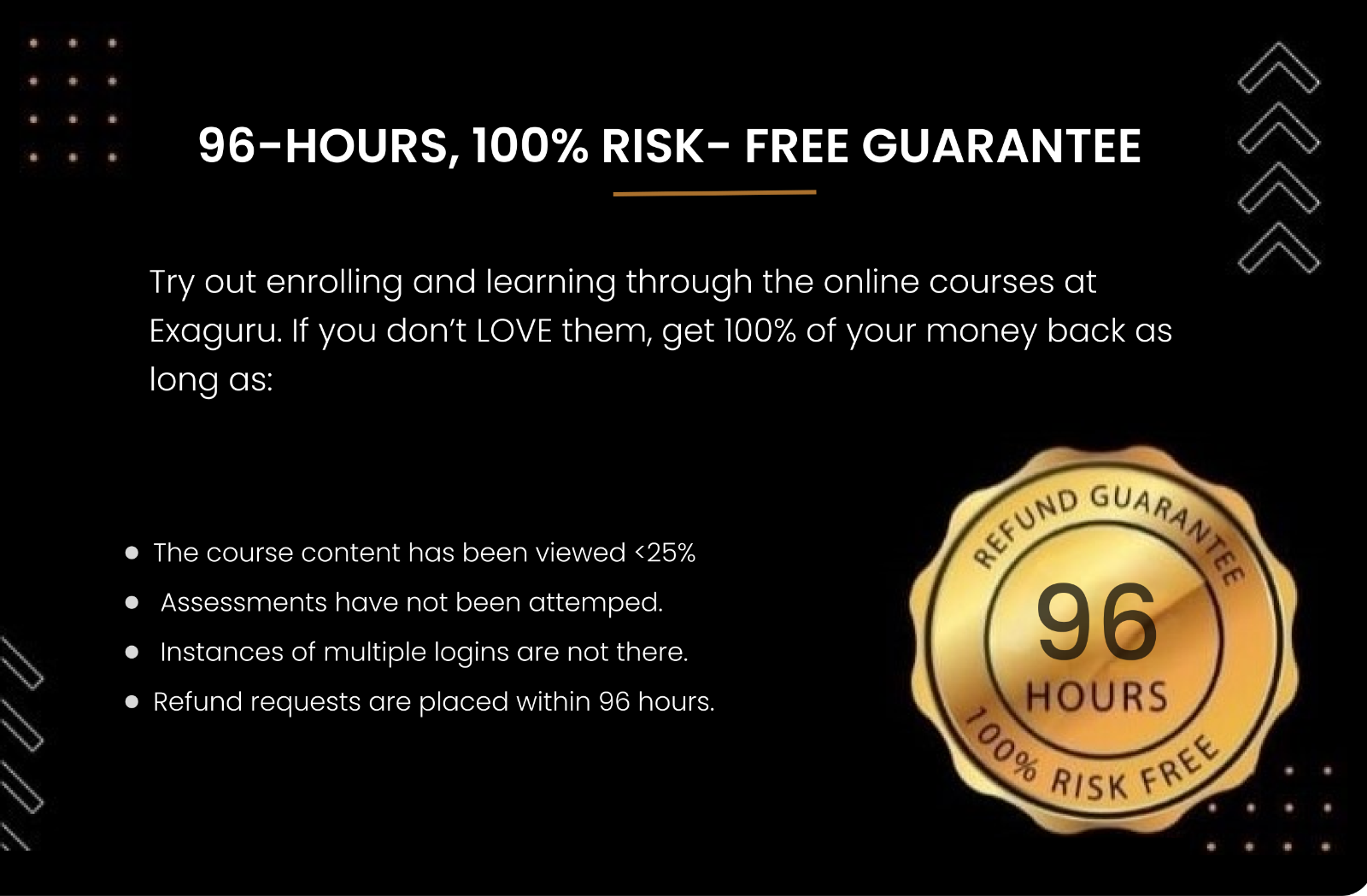
96-Hours Guarantee
Risk-free enrollment — full refund within 96 hours.
What Our Learners Say


Choose Your Plan
Foundations
Cloud Network Engineer path · 5 weeks · capstone included
- 25 live modules
- 5 weekly labs
- Hybrid Enterprise capstone
Architecture & Security
Multi-Cloud Architect path · transit, security, automation
- 25 live modules
- 5 weekly labs
- Global Secure capstone
Level 100 + 200
Complete path from network engineer to multi-cloud architect
- Both levels · best value
- 2 capstones
- Priority placement support
Pricing shared on discovery call · [email protected] · +91-6394049607
96 Hours, Zero Risk
Enroll with total confidence. Sit in on live sessions, work through the labs, and see the teaching quality for yourself. If it's not the right fit, request a full refund within the first 96 hours — no friction, no fine print, as long as:
- Less than 25% of course content has been viewed
- No assessments have been attempted
- The refund is requested within 96 hours of enrollment
Frequently Asked Questions
What is the Multi-Cloud Networking Program?
Is this a Udemy-style video course?
How is the curriculum organized?
What are the two levels?
Who is this program for?
Can I start at Level 200?
Are capstone projects included?
Is OCI included?
What's the weekly time commitment?
Do I need my own cloud accounts?
Who is the lead instructor?
Do you provide placement assistance?
Ready to Become a Multi-Cloud Network Architect?
Spots are limited for the next batch.